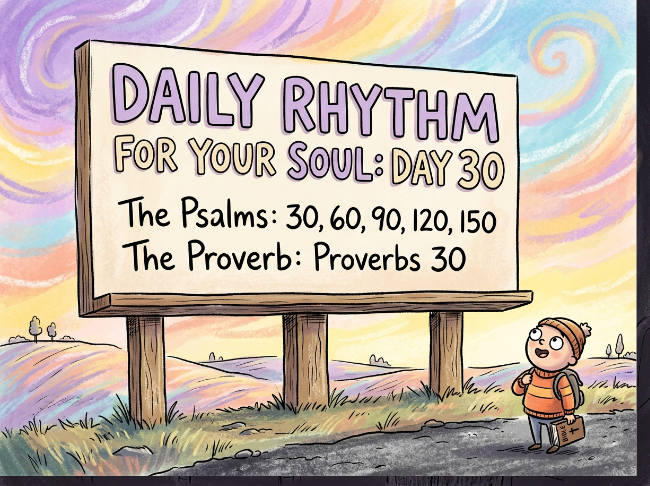
The Psalms: The Great Finale
Today’s selection (30, 60, 90, 120, 150) takes us from the depths of a “pit” to the highest possible praise in the sanctuary.
- Psalm 30 (Joy in the Morning):
- Historical Meat: A Psalm of David written for the dedication of the House of David. He had been through a season of “heaviness.”
- The Deep Dive: “Weeping may endure for a night, but joy comes in the morning.” It’s the meat of Resurrection. It teaches us that God’s anger is but for a moment, but His favor is for a lifetime. He turns our mourning into dancing.
- Psalm 60 (The Banner of Truth):
- Historical Meat: Written when David was at war with Aram-Naharaim and Edom. Things looked bleak for a moment.
- The Deep Dive: David asks God to “give a banner to those who fear You, that it may be displayed because of the truth.” It reminds us that when we feel defeated, we rally around God’s Truth, not our own strength.
- Psalm 90 (The Prayer of Moses):
- Historical Meat: The only Psalm attributed to Moses. He likely wrote this while watching an entire generation pass away in the wilderness.
- The Deep Dive: “So teach us to number our days, that we may gain a heart of wisdom.” It’s the meat of Perspective. It contrasts our “seventy years” with God’s eternity. It’s a call to make every day count for the Kingdom.
- Psalm 120 (The Tongue of Deceit):
- Historical Meat: The first “Song of Ascents.” Worshippers sang this as they began the long walk up the mountain to Jerusalem.
- The Deep Dive: The author is tired of living among “lying lips.” It’s a prayer for Peace. It teaches us that the journey toward God often begins with a realization that we no longer fit in with the world’s dishonesty.
- Psalm 150 (The Loudest Praise):
- Historical Meat: The final Psalm in the Bible. It is a pure explosion of praise.
- The Deep Dive: It lists every instrument—trumpet, lute, harp, timbrel, and “high-sounding cymbals.” The final word of the Psalms is a command: “Let everything that has breath praise the Lord!”
The Proverb: Practical Wisdom
Proverbs 30 (The Words of Agur)
- The Wisdom: This chapter is written by Agur. He speaks with deep humility, asking God for “neither poverty nor riches,” but just enough for the day.
- The Takeaway: It covers the “four small things” that are exceedingly wise: the ant, the rock badger, the locust, and the spider.
The Key Verse: “Every word of God is pure; He is a shield to those who put their trust in Him.”
The Discipline:5 Psalms to learn how to get along with God. 1 Proverb to learn how to get along with man.