The Psalms: From the Cave to the Choir
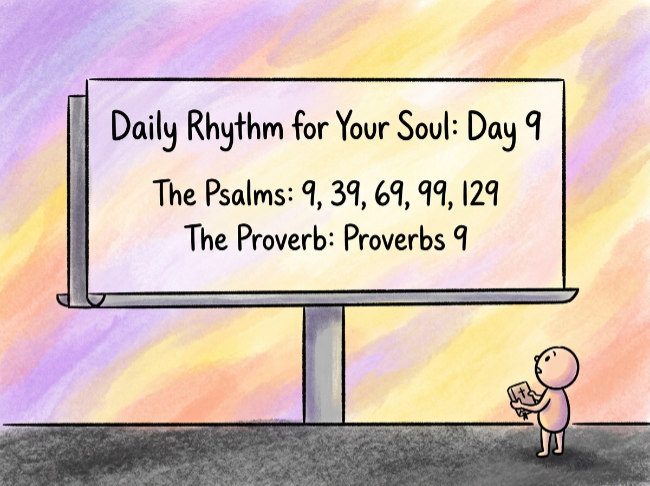
Today’s selection (9, 39, 69, 99, 129) covers a massive emotional range, from David’s military victories to his deepest personal despairs.
- Psalm 9 (The Victory Monument): * Historical Meat: This is believed to be a victory song after David defeated Goliath or the Philistines. It is an “acrostic” (though partially broken), meaning David used the alphabet to organize his praise.
- The Deep Dive: David highlights God as a “refuge for the oppressed.” Historically, this was written when David was establishing the throne. It reminds us that when we win, we shouldn’t credit our own “sword,” but God’s justice.
- Psalm 39 (The Silent Man’s Prayer): * Historical Meat: This is addressed to Jeduthun, one of the three chief musicians appointed by David to lead the temple music.
- The Deep Dive: David is struggling with his tongue. He tried to stay silent so he wouldn’t sin, but his “heart grew hot” within him. It’s a sobering look at the “brevity of life.” David realizes he is just a “stranger and a sojourner,” teaching us to hold our earthly possessions and our words loosely.
- Psalm 69 (The Waters of Affliction): * Historical Meat: This is a “Messianic Psalm,” meaning it points directly to the suffering of Jesus (it’s quoted in the New Testament more than almost any other).
- The Deep Dive: David describes being in “deep mire” where there is no standing. He is being hated “without a cause.” Historically, this mirrors the betrayal David felt from his own countrymen. It teaches us how to pray when we feel like we are drowning in someone else’s drama.
- Psalm 99 (The Footstool of Holiness): * Historical Meat: This Psalm explicitly mentions Moses, Aaron, and Samuel.
- The Deep Dive: It focuses on the “Holy” nature of God. Three times it declares “He is holy.” It reminds us that while God is our friend, He is also the King who spoke to the pillars of cloud. It’s a call to “exalt the Lord” at His holy hill.
- Psalm 129 (The Scars of the Past): * Historical Meat: A “Song of Ascents.” It looks back at Israel’s history of being “plowed” by enemies.
- The Deep Dive: It uses the graphic image of enemies plowing long furrows into a back. Yet, it ends with the “righteous Lord” cutting the cords of the wicked. It’s a song for the survivor—reminding us that though we’ve been afflicted, we haven’t been defeated.
The Proverb: Practical Wisdom
Proverbs 9 (A Tale of Two Banquets)
- The Wisdom: This is the grand finale of the “Prologue” of Proverbs. Solomon sets up a contrast between two women: Lady Wisdom and Lady Folly.
- Lady Wisdom has built a house with seven pillars, prepared a feast, and invited everyone to “forsake foolishness and live.”
- Lady Folly is loud and “knows nothing,” sitting at the door of her house calling people to eat “stolen water” and “bread eaten in secret.”
- The Takeaway: Both Wisdom and Folly are looking for “guests.” Wisdom leads to life; Folly leads to the “depths of hell.” The difference is in the invitation. Wisdom offers a prepared meal; Folly offers stolen snacks.
The Key Verse: “The fear of the Lord is the beginning of wisdom.”
The Discipline: 5 Psalms to learn how to get along with God. 1 Proverb to learn how to get along with man.